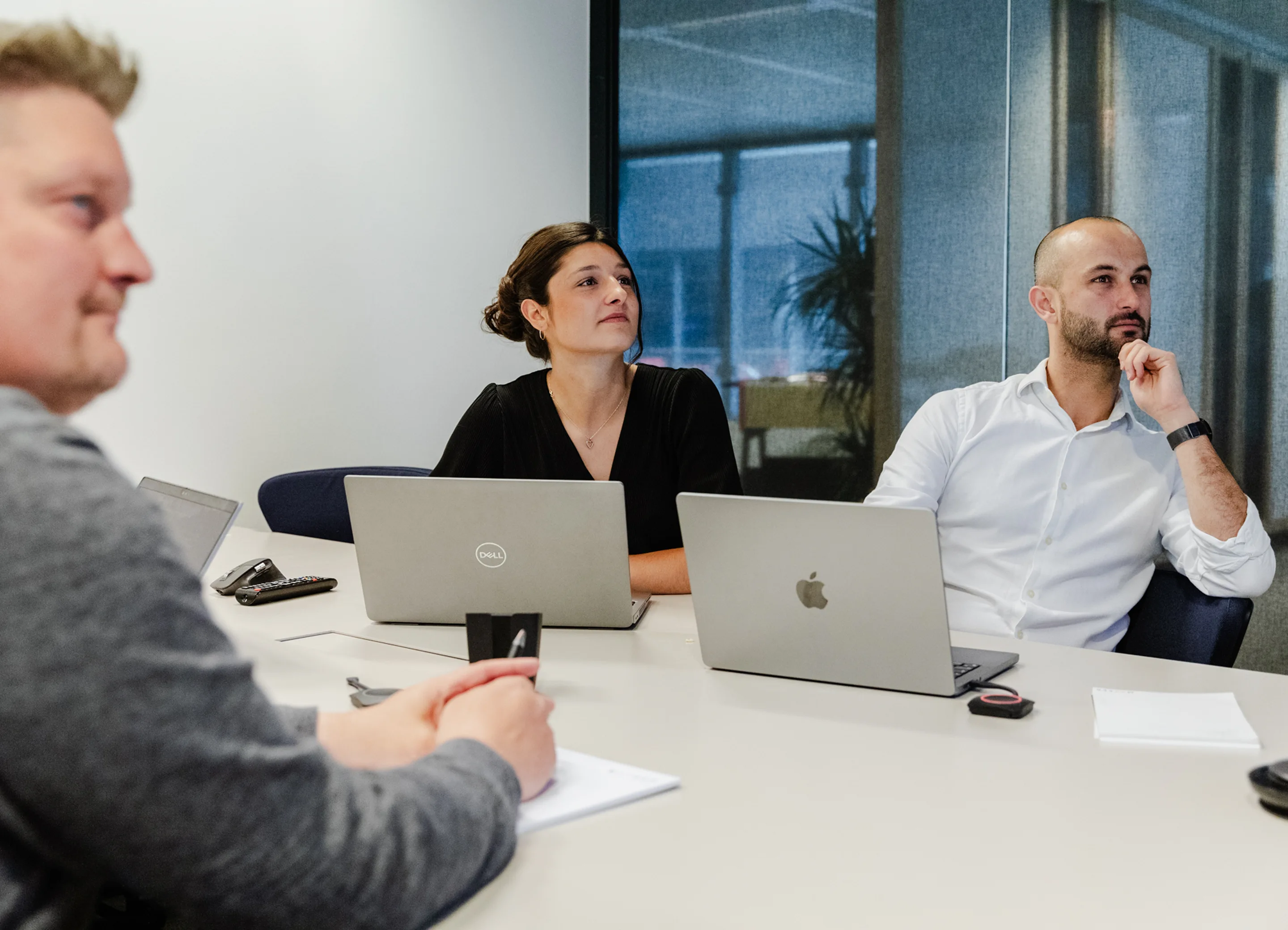
Oleon closes the SAP-to-shop-floor gap: one MES cockpit makes every batch traceable
Together with Mayker, Oleon built a custom MES on the Mendix platform, the link between SAP and the Siemens system that runs the installations. Dirk Van den Bergh and Gino De Soomer explain how that is changing the site in Oelegem.



The challenge
Proving how every batch was made, without drowning in manual bookings
Oleon makes more than 300 different products at its Oelegem site, but SAP and the shielded Siemens system that runs the installations only exchanged records by hand. An additional certificate for the cosmetics market demanded proof of what was produced when and in what quantity, at a level of detail manual entry could not sustain.
What we did
A custom MES on Mendix, between SAP and the OT system
We mapped more than a hundred production routes through the plant and built each one in a custom MES on Mendix, linked to SAP and to the Siemens OT system through a single monitored gateway. Orders now reach the floor and production flows back automatically, with every batch traceable to the reactor, the day and the ingredients.
Key statistics of this case
300+Different products at the Oelegem site
100+Production routes built and tested
1 clickReplaces the manual booking in SAP
Oleon produces more than 300 physically different products from vegetable oils, using four reactors and a wide range of post-treatment steps at its site in Oelegem. That flexibility ran into a hard limit at the connection between two systems: SAP handled planning and inventory, while a tightly shielded Siemens system controlled the installations directly, and records moved between the two by hand.
A flexible plant needed proof to match its production
Oleon’s cosmetics customers count on an additional certificate, and to earn it, Oleon needed to demonstrate conclusively which product was consumed when and in what quantities. Before MES, records from the Siemens system reached SAP only through manual entry. The OT system is, for safety reasons, deliberately shielded from the standard IT environment, and a chemical plant allows no compromise on that front.
“Everything ran through Siemens and was then entered manually into SAP. We looked into a middle layer that would make the connection between Siemens and SAP.”
Gino De Soomer, Applications Owner, Oleon
The certificate called for follow-up on every booking, at a level of detail that manual entry could not sustain.
“If we had to do this level of follow-up manually, we would drown in manual bookings.”
Dirk Van den Bergh, Continuous Improvement Coordinator, Oleon
A platform flexible enough to match Oleon’s own flexibility
Oleon needed a platform flexible enough to match its own production flexibility, not a rigid package that would force the plant into a straitjacket. That search led to an MES built on Mendix, and to Mayker’s proof of concept: built around the plant’s concrete questions and needs, it’s what won Oleon over. The collaboration has continued well past go-live, from aftercare to the ongoing rollout to other locations.
“Their approach was to listen closely, almost deferentially so: what do you want to achieve, and how do you want to achieve it? And then they worked with us to find the best way to build it.”
Dirk Van den Bergh, Continuous Improvement Coordinator, Oleon
More than a hundred production routes, worked out one by one
The team mapped which routes a product can follow through the plant and identified more than a hundred different paths, each worked out in Mendix, tested and retested. When a tested route turned out to work differently in practice, the team looked for a better approach together. The security architecture held up throughout: the connection between the systems runs through a single, tightly monitored gateway to the OT system.
“Despite the complexity and the plans that sometimes changed along the way, they handled it with real flexibility. This was genuinely detailed, tailored work, and they were good at it.”
Dirk Van den Bergh, Continuous Improvement Coordinator, Oleon
Operators work in one environment and the plant registers every movement
Orders arrive from SAP in MES, operators carry out their tasks directly in the cockpit, and every booking flows automatically to the right systems. Without the MES layer, an operator emptying a tank would have to wait until the manual booking in SAP was done before the next unload could proceed. Now that step happens directly from the OT system.
“As a user, you basically no longer need to be in SAP. Emptying a tank is now one click in our OT system, the booking happens automatically in SAP, and operators can move straight on to the next unload.”
Gino De Soomer, Applications Owner, Oleon
Planning benefits too: they line up their orders in SAP, check in MES that everything is in order, and can head into the weekend with peace of mind. Because the systems now form a single chain, logistics, quality and production work more closely together than before.
Every batch is provable down to the reactor
The heart of the project is proof, not just production. After a period in which the plant built up sufficient evidence, Oleon passed the first stage of the external audit for the new certificate in September 2026. Because the systems are linked, a product can technically only leave the site once it has been checked on every level.
“In the batch record we can trace exactly how a product was built: on which days, on which reactors, with which ingredients. We can prove, beyond doubt, that this is how it was produced.”
Dirk Van den Bergh, Continuous Improvement Coordinator, Oleon
The cockpit’s reach is spreading across the locations
Custom manufacturing applications like this one keep evolving after go-live. The rollout to the other locations is already underway. Emmerich (Germany) is running a first variant where users work directly in SAP through simple forms, and Conroe (US) is next on the roadmap. Oelegem remains the largest block, with the full integration between SAP, MES and the OT system.
“There’s a question, and there’s a quick answer. You are not left to fend for yourself, not at all. As far as I’m concerned, I’d definitely recommend them.”
Gino De Soomer, Applications Owner, Oleon
From the shop floor, into practice.


How PSS built a digital manufacturing culture with a custom Mendix MES
How do you build a digital culture that operators actually embrace and keep using? Premium Sound Solutions produces 120 million speakers a year across six global plants for automotive and consumer goods where traceability and quality are non-negotiable.

How BESS brought its MES live in three months with Mayker and Mantsu
BESS International’s production volume had roughly doubled since 2023, but execution on the shop floor still depended on Excel, printed production orders and paper forms. The company wanted a practical first step, not a long and heavy MES programme. Mantsu provided the modular product foundation; Mayker brought the manufacturing and implementation expertise to make it work in the reality of BESS’s production lines.
OEE the Mendix way
Today we’re talking about OEE, or Overall Equipment Effectiveness for those in the know. OEE is a metric for measuring productivity of any given process, primarily within the manufacturing industry.
Mayker launches Mantsu: a composable MES that gets factories to efficiency gains in weeks
Technology company Mayker is launching Mantsu, a composable MES that brings factories to measurable efficiency gains in weeks instead of months, making hidden efficiency losses visible and steerable without the heavy, months-long projects of a classic MES.