How BESS brought its MES live in three months with Mayker and Mantsu
BESS International’s production volume had roughly doubled since 2023, but execution on the shop floor still depended on Excel, printed production orders and paper forms. The company wanted a practical first step, not a long and heavy MES programme. Mantsu provided the modular product foundation; Mayker brought the manufacturing and implementation expertise to make it work in the reality of BESS’s production lines.


The challenge
Production volume doubled, but the floor still ran on paper
Since 2023 BESS International’s production volume had roughly doubled, while the weekly plan lived in Excel, production orders were printed and taken to the lines, and operators completed their checks on paper. Anyone who wanted to know whether an order was running, delayed or finished had to walk onto the production floor and look.
What we did
Mantsu on one production line, live in three months
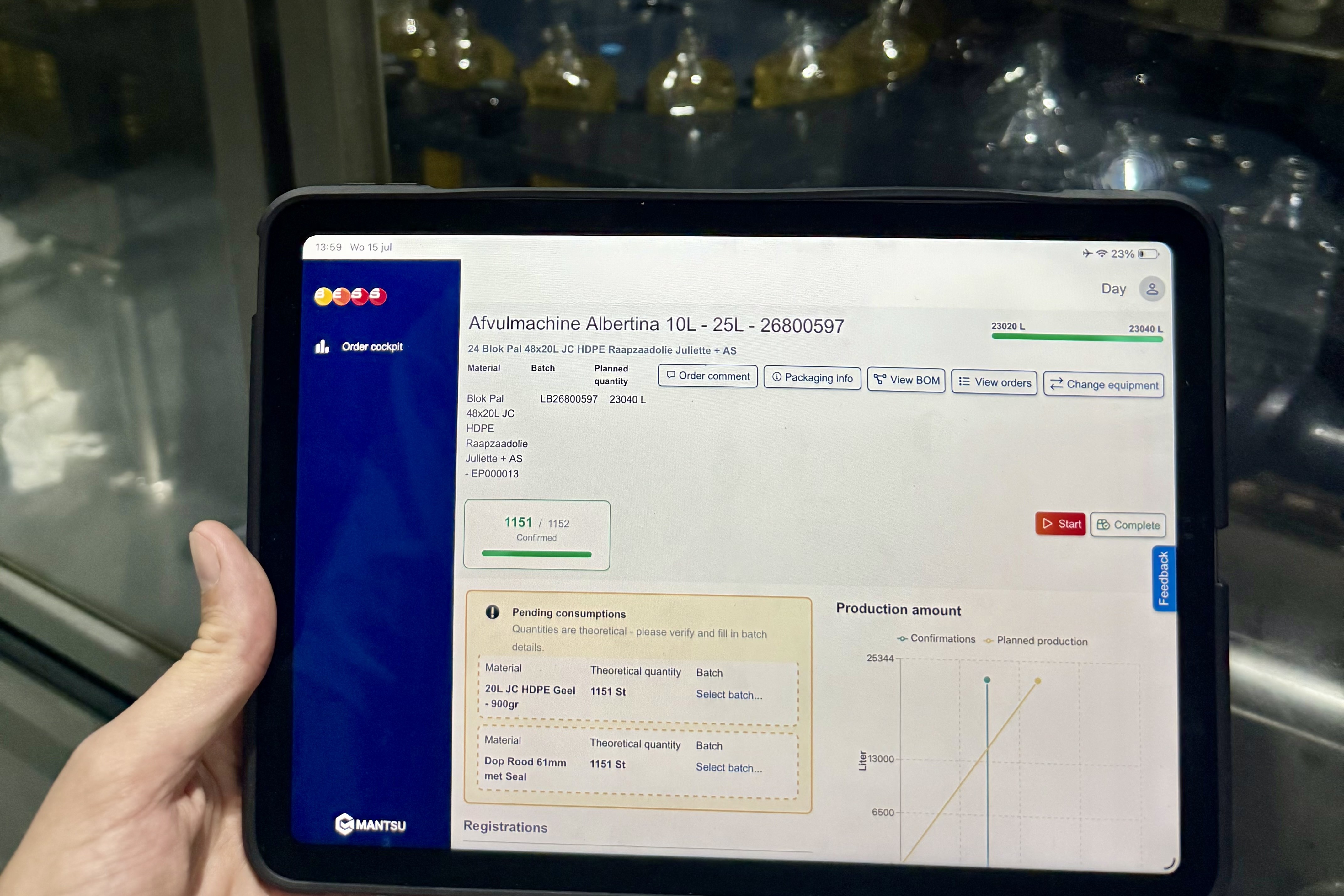
We started on a single line with the Order Cockpit, Downtimes and Lists modules, adapting the standard checklists to the controls that food production at BESS requires. Old and new ways of working ran side by side during the switch, so operators could get used to the system without putting production at risk.
Key statistics of this case
2xProduction volume since 2023
3 monthsFrom project start to go-live
40%Of downtime caused by short stops
BESS International produces and supplies cooking and frying oils from the port of Antwerp. The company works mainly for private-label customers, alongside its own Juliette brand, and packages oils in formats ranging from consumer bottles to industrial volumes.
Growth exposed a manual production flow
Since 2023, production volume has roughly doubled. That growth prompted BESS to review its wider sales-to-cash process and identify where work was accumulating, being duplicated or depending too heavily on individual people. Production execution became a logical first step: the ERP already held the master data and generated the production orders, but almost everything that followed still required manual work.
The weekly production plan was maintained in Excel. Production orders were printed and taken to the lines. Operators completed checks on paper, after which the documents were scanned and information was entered again in the administrative systems. Anyone who wanted to know whether an order was running, delayed or completed often had to walk onto the production floor and check.
A lean team needed more than a software supplier
Jonathan Brits, responsible for Operations and IT at BESS, compared several possible solutions, including custom development and larger industrial platforms. But the decision was not based on the software alone. BESS is a lean organisation, with a fixed team of around ten people, and it did not have a large internal project team available to explain every production process to a software supplier from beginning to end.
“It was very important to me to find a partner with a solid base of manufacturing know-how that could guide me through the process.”
Jonathan Brits, Operations and IT, BESS International
Mantsu provided the product starting point: existing modules for production order execution, downtime tracking and Standard Operating Procedures. Mayker brought the manufacturing expertise needed to implement those modules and adapt them where BESS’s own processes required it. A reference visit to another Mayker customer, already using the solution across multiple production sites, helped build confidence that the platform could support a larger and more complex operation.
From operational context to a working configuration
The implementation ran from mid-March to mid-June 2026. Before configuring the applications, the Mayker project team first had to understand how production at BESS related to the existing ERP, the production orders and the controls required on the shop floor.
“The Mayker team was up to speed with everything in a very short time. That is something I really appreciated.”
Jonathan Brits, Operations and IT, BESS International
Every production order at BESS carries its own set of checks. During configuration, the team saw that operators needed a direct way to retrieve those checks by production order number, and adapted the standard Lists module to the way BESS manages its food-production controls. Some of the existing PLCs and counters were difficult to access for automatic production confirmations. Instead of proposing additional hardware, Mayker worked with BESS to determine which data could be retrieved from the existing setup.
“Mayker thought things through with us and was open about the options. We agreed the budget upfront, and the project stayed within it.”
Jonathan Brits, Operations and IT, BESS International
Going live without compromising production stability
BESS introduced Mantsu on one production line first. When an operator starts an order, the system opens the corresponding checklist: the selected ingredients, packaging and labels, machine readiness and the required flushing procedure. At the end of the order, the operator completes the final checks and enters the consumption figures before closing it.
“We work in food, so traceability is paramount. We have to know exactly which packaging goes into which production run and which oil goes into which bottle.”
Jonathan Brits, Operations and IT, BESS International
Because BESS produces food products, the transition was deliberately gradual. The old and new ways of working initially ran alongside each other while the team gained experience. That phased rollout also created room for operators to give feedback on screen positions, the order flow and the number of steps needed to complete particular actions.
What changed first
The most immediate change is visibility. Production orders no longer disappear into a combination of printed documents, Excel files and local knowledge. Operators move from one order to the next on the screen, while the wider team follows progress through the production dashboard.
“We can see on our dashboard how many orders are running, whether there is downtime and whether we are on schedule. That is our biggest win at the moment.”
Jonathan Brits, Operations and IT, BESS International
By the end of August 2026, around fifty production orders had gone through the Order Cockpit. The Downtimes module is also beginning to reveal losses that were previously difficult to see: the first data showed more short stops of under ten minutes than expected. Individually these may be caused by something as small as a bottle sitting incorrectly, but together they represent a meaningful source of lost production time.
From visibility to systematic improvement
BESS has not attempted to digitise every operational flow at once. Planning, container loading and parts of the wider administrative process still sit in other tools. But production execution is becoming visible, and BESS now has a practical basis for deciding what to improve next, using evidence from the floor rather than assumptions.
BESS started with one production line and one clearly defined need. Mantsu provided the modular foundation; Mayker helped make it fit the reality of the operation. More manufacturing stories show how other producers took their first step.
Still bridging the gap between your ERP and the production floor with paper, Excel or disconnected tools? Talk to Mayker about the right first step for your operation.
From the shop floor, into practice.


How PSS built a digital manufacturing culture with a custom Mendix MES
How do you build a digital culture that operators actually embrace and keep using? Premium Sound Solutions produces 120 million speakers a year across six global plants for automotive and consumer goods where traceability and quality are non-negotiable.

Oleon closes the SAP-to-shop-floor gap: one MES cockpit makes every batch traceable
Together with Mayker, Oleon built a custom MES on the Mendix platform, the link between SAP and the Siemens system that runs the installations. Dirk Van den Bergh and Gino De Soomer explain how that is changing the site in Oelegem.
OEE the Mendix way
Today we’re talking about OEE, or Overall Equipment Effectiveness for those in the know. OEE is a metric for measuring productivity of any given process, primarily within the manufacturing industry.
Mayker launches Mantsu: a composable MES that gets factories to efficiency gains in weeks
Technology company Mayker is launching Mantsu, a composable MES that brings factories to measurable efficiency gains in weeks instead of months, making hidden efficiency losses visible and steerable without the heavy, months-long projects of a classic MES.